

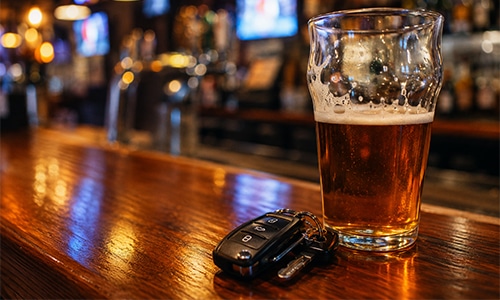
The distinction matters, but safety comes first. TxDOT reports that 1,254 people died on Texas roads because of impaired driving in 2025, which was about three people each day.
What Does Drinking and Driving Mean Under Texas Law?
The phrase can describe different conduct. Texas law treats each situation according to its own elements.
Can an Adult Drive After Drinking Alcohol?
Although consuming alcohol prior to operating a motor vehicle will not by itself constitute driving while intoxicated (DWI), pursuant to Texas Penal Code Sections 49.01 and 49.04, the State must demonstrate that the person operated a motor vehicle in a public place while intoxicated. The State can show the person’s intoxication through either an alcohol concentration level of .08 or higher, or through a loss of the normal use of either their mental or physical faculties due to alcohol, drugs, a combination of substances, or another substance.
Even though a result less than .08 would not provide safety from prosecution, the lower result would indicate that the numerical definition of intoxication was not met; however, the State could still demonstrate a loss of faculties. Additional information concerning alcohol concentration levels, testing, commercial drivers, and persons under twenty-one years old can be found in the separate article entitled legal limit of alcohol in texas.

Drunk Driving Accident Lawyer
Call for YOUR FREE Case Review
Hurt?
Let Jay and His Team Help You!
Call for YOUR FREE Case Review
Why Drinking Inside the Vehicle Is a Separate Offense
Under Texas Penal Code Section 49.031, a person commits an offense if he/she knowingly possesses an open container in the passenger area of a motor vehicle being operated upon a public road. Whether or not the vehicle is stationary, parked, or in motion, the statute applies.
For this particular violation of law, the State need not prove that you were intoxicated. Instead, the State must merely prove that you knowingly possessed an open container which meets the definition set forth in the statute and that such container was situated within the passenger area of a motor vehicle traveling upon a public highway.
Related Article(s)
What Is the Legal Alcohol Limit in Texas?
What Happens If You Crash Your Car While Drunk in Texas?
What Counts as an Open Container?
An “open” container is defined as follows:
- an open beer;
- a partially consumed liquor bottle;
- a wine bottle which has been recorked after opening;
- a small container filled with alcohol; or
- a cup containing a mixed drink.
However, simply because a receptacle contains some amount of alcohol does not make it an “open” container. If a receptacle is totally empty, then it is not considered to be an “open” container pursuant to Section 49.031. With this in mind, such receptacle could still be utilized as evidence during investigation.
Where Can Opened Alcohol Be Stored?
The term “passenger area” refers to that area designated for seating the driver and passengers. There are three areas excluded from this definition:
An unopened bottle containing alcoholic beverages sealed by the manufacturer remains outside the purview of Texas Penal Code § 49.031. Additionally, some alcoholic beverages sold at restaurants or permitted establishments require specific transporting methods, described in further detail in subsequent sections.
Does the Rule Apply to Passengers?
Yes. Texas Penal Code § 49.031 relates to the possessor of an open container, not the operator of the vehicle. As such, a passenger in an automobile can be convicted under Texas Penal Code § 49.031 for knowingly possessing an open container in the passenger area while the vehicle is operating on a public highway. Possession is determined individually and based on factual evidence. Simply being present near an open container does not automatically equate to possession by each occupant. Factors influencing proof of possession include knowledge of the existence of the open container, proximity/accessibility to the open container, ownership/possession/control over the container and/or statements made regarding the same.
Are There Any Exceptions to These Rules for Passengers?
There are exemptions for passengers found in either of the following situations:
- passenger area of a motor vehicle designed, maintained or used to transport individuals for hire (i.e., buses, taxis, limousines); and,
- living quarters of motor home coach/motor home trailer and self contained camper/rv/van.
These exemptions are specifically stated to relate only to passengers. They do not provide permission to consume alcoholic beverages by the operator. The exemption does not modify the DWI statute.
How Should Alcohol to Go Be Transported?
 When considering how to transport alcohol to-go, Texas allows for multiple types of alcoholic beverage pickups and deliveries. However, the requirements for packaging will vary depending on both the type of seller’s permit and the type of beverage. Therefore, current TABC pickup and delivery guidance for pickup and delivery should be reviewed to determine which type of permit will apply.
According to TABC’s transportation notice, for alcohol sealed by an eligible mixed beverage permit holder or private club under the authority of House Bill 1024, such beverages cannot be taken into the passenger area. They should be stored in either a trunk, behind the back seat (if there is no trunk), or in a lockable glove compartment or similar lockable storage area.
A restaurant-applied lid does not equate to an original manufacturer seal. To ensure clear compliance and minimize potential confusion, store all alcohol to-go items outside the passenger area and do not break the seal on them until the end of your trip.
Does the Law Cover a Parked Vehicle?
Yes, if your vehicle is located upon a public highway. Section 49.031 specifically includes stationary vehicles when determining whether Section 49.031 applies.
Section 49.031 defines public highway as “the entire width between and immediately adjacent to the boundary lines of a public road, street, highway, interstate or other publicly maintained way when any part thereof is open for public vehicle travel.” This may include parking lots owned by individuals; however, this could potentially create a different question. In terms of DWI law, the term public place is used broadly enough to cover almost any circumstance where you are found in violation of DWI laws.
What Are the Penalties for an Open Container?
Having an open container in accordance with Section 49.031 constitutes a Class C misdemeanor. As per the Texas Penal Code Section 12.23, a Class C misdemeanor is punishable by fines up to $500.00.
Pursuant to Texas Transportation Code Section 543.002, if only an open container offense is alleged against you and you agree to pay a written promise to appear, then the officer shall issue a written notice to appear. Any additional alleged offenses may alter what occurs during your interaction with the police.
In addition, the existence of an open container can affect the penalties associated with a DWI conviction. If you are convicted of DWI and the state proves that you possessed an open container in your immediate control while operating a motor vehicle, the offense becomes a Class B misdemeanor, but the minimum jail time increases from seventy-two hours to six days.
What Changes for a Driver Under 21?
Under Texas Alcoholic Beverage Code Section 106.041, a person under 21 can commit a separate offense by operating a motor vehicle in a public place while having any detectable amount of alcohol in the person’s system. A driver under 21 may also face DWI when the Penal Code definition of intoxication is satisfied.
Pursuant to Texas Alcoholic Beverage Code Section 106.041, if you are less than 21 years old, then you can separately be convicted of violating section 106.041 by operating a motor vehicle in a public place while possessing any measurable quantity of alcohol. In addition, if you are less than 21 years old, you can be convicted of DWI if your blood or breath alcohol concentration level meets the definition of intoxication contained within Chapter 14 of Title 10 of the Texas Penal Code.
This section stays brief because our separate legal alcohol limit article addresses zero tolerance, license consequences, and the distinction between the underage offense and DWI. We welcome you to check out that article as well for further knowledge.
How Can You Reduce Legal and Safety Risk?
- Choose a sober driver before beginning drinking.
- Use a taxicab, bus, or another form of transportation whose driver is sober when you anticipate that your ability to operate safely may be affected by alcohol consumption.
- Simply because you feel fine doesn’t mean you’re not impaired.
- There are no guarantees that taking an online alcohol calculator prior to operating will protect you from DWI prosecution.
- Always keep containers containing opened or restaurant-sealed beverages outside the passenger area.
- Never assume that your parked vehicle or a passenger’s open container will fall outside of the scope of the law.
If a Drinking Driver Causes a Dallas Crash
 A drunk driving charge (DWI) and open container citation are two different types of offenses; however, if you were injured by the drunk driver, your injury claim is a civil issue. An open container could provide some useful investigative information for your case, but the mere presence of an open container is not proof that a driver was under the influence at the time of the collision. In addition, having blood alcohol content less than .08% would not automatically disqualify an injured party from establishing negligence based upon other relevant collision evidence.
For more details regarding determining fault, obtaining evidence, compensable damages, dealing with insurance, and time limits following an auto accident caused by someone who has been drinking, see our Dallas DWI accident attorney webpage. We have intentionally kept this material off of the general claim webpage so as not to duplicate the potential use of this webpage as a research tool.
Hurt? Let Jay and His Team Help You
Call for YOUR FREE Case Review
 (214) 855-1420
Injured by a Drinking Driver in Dallas?
If a driver who had been drinking or impaired caused an injury to you or a family member, Jay Murray Car Accident and Truck Accident Lawyers can review the collision and explain the civil claim process. Contact the firm to request a consultation. Past results do not guarantee a similar outcome.
One beer will not automatically make it unlawful for you to operate a motor vehicle if you are at least 21 years of age. You must still avoid impaired driving and remain free from any other type of alcohol related offense. No set number of drinks provides certainty that you are legally allowed to drive or that it is safe for you to do so. Regardless of whether your blood or breath test results show less than .08%, having an open beer in your passenger area while operating a vehicle will constitute knowing possession of an open beer and therefore constitute a violation of Section 49.031. The question of whether you are guilty of DWI is a separate question. Yes. Whether it has been recorked or otherwise closed or partially consumed, if there is still liquid left inside of the container, then it is considered an open container. Breaking a seal originally put on the container by its manufacturer or removing some portion of its contents will render it subject to the provisions outlined above. Yes, if properly positioned. In vehicles without a trunk (such as SUVs, hatchbacks, or station wagons), opened or restaurant-sealed alcohol must be stored behind the last upright seat or inside a locked glove compartment or similar locked storage container pursuant to Texas Penal Code Section 49.031(a)(2). Unlocked glove boxes or center consoles do not qualify. Yes. The passenger who knowingly possesses an open container can violate Section 49.031 regardless of whether the driver was consuming alcohol while operating their vehicle. The burden is on the State to establish that the passenger knowingly possessed the open container and did not merely assume responsibility for everyone else in the vehicle. Not according to TABC. TABC states that beverages sealed pursuant to the authorization described in HB 1024 may only be transported in a trunk, behind the last upright seat when there is no trunk available, or in a lockable glove compartment or similarly lockable enclosed area. No. Section 49.031 explicitly includes stationary vehicles located on a public highway when determining whether Section 49.031 applies. This article provides general information about Texas law and is not legal advice for any particular situation.Frequently Asked Questions
Can I legally drive after one beer as an adult?
Will drinking from an open beer result in charges against me if my blood or breath test shows below .08%?
Is a recorked bottle of wine still considered an open container?
Can opened alcohol be carried in a sport utility vehicle?
Can a passenger be cited even when the driver is sober?
Can a restaurant-sealed alcohol ride in the front seat?
Does parking on a public street create an exception?
 Call (214) 855-1420
