


Quick Answer: Can You Dispute Fault in a Texas Car Accident?
Yes, you can absolutely dispute fault, and in many cases, you most definitely should.
Tons of drivers assume that once a decision is made on the scene or during an initial insurance review, the case is completely closed.
The reality is that fault is not final after:
- Police Reports: A responding officer’s report is an important piece of evidence, but it is ultimately an educated opinion formed after the crash occurred. Officers are not immune to making mistakes, missing witness statements, or misinterpreting how the vehicles collided.
- Insurance Decisions: Insurance companies are private corporations looking out for their own financial bottom lines. An initial denial or fault determination by an insurance adjuster is simply their corporate position; it is not a binding legal verdict.
If the initial fault assessment is inaccurate, you do have every right to challenge it with objective evidence.

Hurt? Let Jay and His Team Help You
Call for YOUR FREE Case Review
 (214) 855-1420
How Fault Works in Texas (Why Disputing It Matters)
We know disputing fault is not just about protecting your driving record; it directly impacts how much money you can actually take home to cover your medical bills and lost wages.
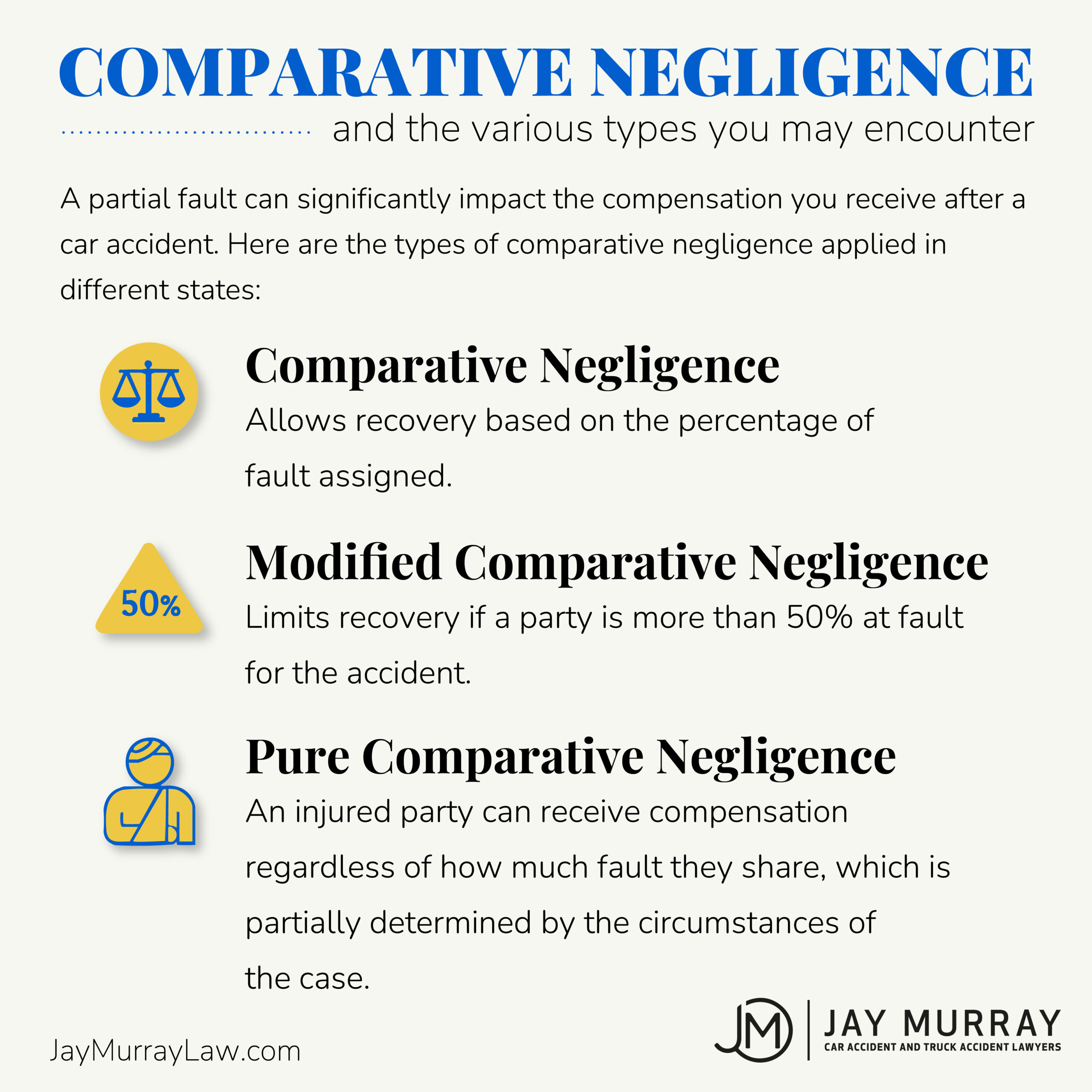
Texas Modified Comparative Fault Rule
- Texas operates under a legal standard known as modified comparative fault (specifically, a 51% bar rule). This means you are legally allowed to recover financial compensation from another driver as long as you are found to be 50% or less at fault for the accident.
- However, if the insurance companies or a court determines you are 51% or more at fault, the law bars you from recovering a single dollar of compensation, leaving you completely on your own for your expenses.
How Fault Percentage Impacts Your Settlement
- Even if you are allowed to recover money because you are under that 51% threshold, any percentage of fault assigned to you will act as a direct deduction from your final check. This means if you are found to be 20% at fault for an accident, your final settlement is automatically reduced by 20%.
- Example: Say your total damages (including your ER bills, physical therapy, and lost income) total $100,000. If the insurance company successfully claims you were 20% to blame because you were driving slightly over the speed limit when another driver ran a red light, your payout is capped at $80,000. Disputing that 20% can mean a difference of tens of thousands of dollars.

When You Should Dispute Fault
You shouldn’t just accept a poor insurance evaluation, especially if it is full of discrepancies. You should actively dispute a fault determination if any of the following scenarios apply to your accident:
- You were wrongly blamed entirely: The other driver caused the crash, but they lied to their insurer, and now you are being stuck with 100% of the responsibility.
- You were assigned too high a percentage: You accept that you might have been rolling slowly at the time, but the insurer is trying to claim you are 40% responsible for an accident that was clearly 90% the other driver’s fault.
- Inaccurate police report: The responding officer wrote down the wrong sequence of events, mixed up the drivers, or left out critical witness statements that clear your name.
- Insurance company completely denied your claim: The at-fault driver’s insurance carrier refused to pay out, claiming their policyholder did nothing wrong.
Related Article
What Are the Odds of Dying In a Car Crash?
Step-by-Step: How to Dispute Fault in a Texas Car Accident
Disputing fault requires a systematic approach backed by hard physical evidence. Here is a process that may be used to overturn a wrongful fault determination:
Step 1: Get the Police Report
A police report is usually the first major document an insurance adjuster looks at. You need to request an official copy immediately, as it may establish a baseline narrative for your claim. Once you have it, review it thoroughly to look for the following:
- Factual errors (incorrect dates, wrong street names, or mixed-up vehicle diagrams).
- Missing statements from passengers or independent witnesses who spoke to the officer on the scene.
- Incorrect assumptions made by the officer regarding vehicle speeds or point of impact.
Step 2: Gather Strong Evidence
Evidence is in fact the foundation of any fault dispute. Unfortunately, you cannot win an argument with an insurance adjuster based on your word alone; you must present objective data and evidence that forces them to change their mind, including:
- Pictures and Videos: Clear pictures and footage of the crash scene, skid marks, traffic signs, road conditions, and the positioning of the vehicles immediately after impact.
- Witness Statements: Retrieve contact details and written or recorded accounts from bystanders who saw the crash unfold with their consent.
- Medical Records: Direct documentation proving your injuries that line up with your account.
- Vehicle Damage Analysis: Photos showing the precise crush points on both vehicles, which can mathematically prove the angles of impact.
- Traffic Camera Footage: Security feeds from nearby businesses or municipal traffic cameras that captured the incident. There are also companies that have access to DOT footage available for request, such as specialized archive networks like RoadProof, which preserve millions of hours of traffic data for up to a year. Platforms may restrict database access strictly to licensed attorneys and law enforcement, so having a law firm that works with RoadProof pull this data early can quite literally make or break your case.
Dallas Car Accident Lawyer
Call for YOUR FREE Case Review
Hurt?
Let Jay and His Team Help You!
Call for YOUR FREE Case Review
Step 3: Identify Fault Errors
Look for flaws in how the initial decision was made. Insurers often make broad assumptions too quickly. This may include assuming the rear driver is always 100% at fault in a rear-end collision, completely ignoring the fact that the front driver may have aggressively cut them off and slammed on the brakes. It’s important to identify where they may have missed critical context or showed an obvious bias toward their own policyholder.
Step 4: Challenge the Insurance Company’s Decision
- After your evidence is organized, your lawyer will formally submit a dispute package to the insurance carrier. This typically involves:
- demanding a formal reassessment of the claim;
- presenting new evidence;
- and pushing back on the insurance company’s initial, flawed conclusions with physical proof if present.
Step 5: Dispute or Correct the Police Report (If Needed)
Because police officers arrive after the vehicles have already collided, their reports are not always 100% accurate.
- If the report contains objective errors (like a wrong driver’s license number or a typo about a traffic sign), you can request an amendment.
- If the officer made an assumption about fault that you disagree with, you can submit an official supplemental statement containing your evidence to be permanently attached to the state crash file.
Step 6: Bring in Expert Evidence
When a case involves a collision or conflicting stories, bringing in expert non-biased specialists can completely change the dynamic.
If you have a lawyer involved, they may have experts or external parties on retainer who can download black box data, find traffic camera footage, analyze vehicle weights, and build a digital simulation of the crash that mathematically proves who caused the impact.
Step 7: Hire a Texas Car Accident Lawyer
If an insurance company has dug its heels in and refuses to move off a wrongful fault allocation, handling it yourself becomes nearly impossible, especially if you are injured. An experienced attorney can file a formal lawsuit, conduct legal depositions under oath, force the disclosure of internal insurance data, and use formal litigation leverage to shift the fault percentages in your favor.
Common Ways Insurance Companies Try to Blame You
Insurance companies do not look at accidents objectively; they look at them through a lens of risk management. Remember, their main goal is always to protect their corporate profits by reducing claim payouts.
To do this, adjusters rely on these standard tactics to shift blame onto you:
- Misinterpreting your statements: Taking a casual phrase you said right after the crash like “I’m so sorry this happened” and twisting it into a formal admission of legal liability.
- Using partial evidence: Highlighting a single photo of your vehicle damage while completely ignoring the skid marks on the road that prove the other driver was speeding.
- Strategic fault shifting: Intentionally assigning you a minor, arbitrary percentage of fault (like 10% or 15%) knowing that most unrepresented drivers won’t fight back over a small deduction, saving the insurer thousands of dollars across thousands of daily claims.
How to Dispute Partial Fault (Not Just 100% Blame)
Most car accident disputes are not about proving that the other driver was acting entirely lawful or unlawful, as most cases involve a shared allocation of fault. Your primary legal strategy doesn’t have to be proving you did absolutely nothing wrong; it can simply be about systematically reducing your assigned percentage.
- Example: Let’s say you are hit by a commercial van, and the insurer claims you are 40% at fault because you didn’t swerve out of the way fast enough, offering you a reduced settlement of $60,000. But you have clear dashcam footage that proves you had less than a second to react, and you can introduce it as evidence, so your attorney is able to reduce your assigned fault down to 10%. That single adjustment pushes your final take-home payout up to $90,000.
Improving small percentages can still increase your payout in a great way.
What Evidence Actually Wins Fault Disputes
Not all evidence carries the same weight when you are trying to overturn a liability decision.
Most Powerful Evidence
- Raw Video Footage: Dashcam clips or business surveillance videos that show the live crash frame-by-frame.
- Independent Neutral Witnesses: Statements from bystanders who have no financial stake in either driver’s insurance outcome.
- Expert Accident Reconstruction: Mathematical, data-backed physics reports that prove speed, braking, and angles of impact.
Weak Evidence (That People Rely On Too Much)
- Your Personal Statement Alone: A simple “he-said, she-said” argument without any outside documentation to back it up.
- Incomplete Photos: Pictures taken days later showing only clean vehicle damage without showing the context of the roadway or intersection lines.
- Social Media Posts: Trying to use casual online status updates to establish the timeline of a collision.
How Long Do You Have to Dispute Fault in Texas?
In Texas, the statute of limitations for filing a personal injury lawsuit following a car accident is two years from the date of the crash.
However, you should never wait anywhere near that long to dispute a fault determination. Physical evidence can disappear within days, vehicles are repaired or sold, skid marks fade off the asphalt, and local businesses routinely overwrite their surveillance camera footage every 30 days. The faster you act to challenge a decision, the easier it is to secure the evidence needed to win.
What Happens If You Don’t Dispute Fault?
If you choose to just accept a wrongful fault determination from an insurance adjuster, you face long-term financial consequences:
- Reduced Settlement: You will automatically lose thousands of dollars from your check due to the artificial fault percentage deductions.
- Denied Claim: If they successfully push your fault allocation over 50%, you will walk away with nothing, leaving you stuck with lifetime medical debts.
- Loss of Legal Rights: Once you sign a closing agreement or accept a lowball check based on their fault allocation, you permanently waive your right to pursue further legal compensation.
Can You Still Recover If You Were Partially at Fault?
Yes, you absolutely can. As long as your percentage of blame sits at 50% or less, you are fully entitled to collect compensation under the Texas modified comparative fault rule.
Never let an insurance company convince you that you cannot file a claim simply because you made a minor error during the event. The best strategy is always to build a defense that minimizes your exposure and maximizes your potential financial recovery.
Hurt? Let Jay and His Team Help You
Call for YOUR FREE Case Review
Real Example: Disputing Fault Successfully
- The Initial Scenario: Driver 1 was navigating an intersection when a vehicle turning left cut directly across their lane, causing a front-end collision. The left-turning driver, Driver 2, told their insurance company that they had a green arrow, and the responding officer, unable to find neutral witnesses, issued a report blaming Driver 1 for running a solid red light. The insurer denied the claim in its entirety.
- The Evidence Introduced: When a legal team stepped in and immediately canvassed the area, they noticed a nearby commercial security camera that clearly showed Driver 1 had a solid green light, meaning the left-turning driver completely failed to yield the right-of-way.
- The Outcome Difference: Faced with concrete video footage, the insurance company was forced to retract their 100% fault allocation onto Driver 1, dropping their fault to 0%. The case went from a total denial to a full policy-limited settlement covering all medical treatments and lost career earnings.
When to Handle It Yourself vs Hire a Lawyer
If your accident involved only minor property damage, no physical injuries, and an insurance company that is cooperating and offering a fair layout, you may be able to handle the communication on your own.
However, if you suffered serious physical injuries, require ongoing medical treatment, missed substantial time at work, or are facing intense resistance from an adjuster who is actively trying to blame you for the crash, trying to fight them alone is a massive risk. You need an aggressive legal team that understands how to dismantle insurance tactics.
Cooperation from insurance can make a lot of difference; even if your case seems straightforward but insurance is uncooperative, you should contact a legal representative.
Talk to Jay Murray Law About Your Case
You should not be pressured to accept an unfair, inaccurate fault determination from a multi-billion dollar insurance company. At Jay Murray Law, we act as specialized evidence builders and fault reducers, providing you with the exact negotiation leverage needed to flip a wrongful denial into a successful recovery.
We provide a completely free, confidential case evaluation to look over your Texas accident report, review the physical evidence, and show you exactly how we can protect your rights under state law. Reach out to our team at Jay Murray Law today, and let us put our local expertise to work for you.
 Call (214) 855-1420
